
Integrating a single controller that can manage a machine and robots, compared to using separate controllers, can enable faster development for the OEM and increased reliability for the end user.
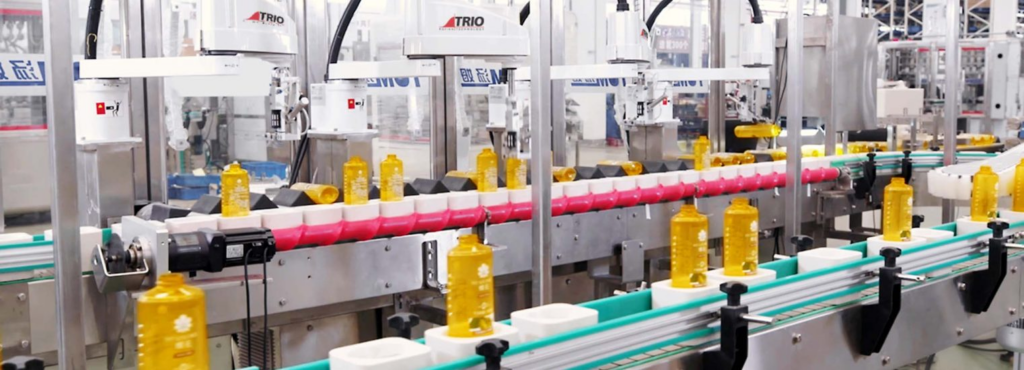
Machine builders are increasingly integrating robotics to maximise productivity and efficiency. But, these advantages can only be achieved if the machine and robot can reliably synchronise. When adding robotics to a machine, third-party robot procurement is the typical approach. However, because most PLCs don’t include integrated robotic control, these robots usually require separate, dedicated controllers.
This presents two main challenges: first, there’s the need for a separate robot controller, demanding extra cost, plus the stocking of its spare parts. This additional controller also requires extra footprint too, on the machine or in the cabinet.
Secondly, there’s the time and complexity of ensuring machine and robot integration, where reliable handshaking between the PLC and robot controller must be established for every machine build. To ensure productivity for the end user, handshaking between these two separate systems has to be reliable. If not, the OEM will be responsible for providing additional support, and if interfacing the machine and robot causes downtime, this can damage trust in the relationship.
The robot integration problem
For many PLC engineers, a robot controller is a separate field of expertise. This means that an OEM either has to invest the time and finances to retrain developers, or they have to recruit dedicated robot experts.
The alternative is to rely on the robot provider for commissioning and support. Without the flexibility of in-house resources, any machine/robot production changes required by the end user will be more difficult to achieve. Giving away management and maintenance responsibility to the robot vendor will also increase overall cost. A two-controller approach, meaning an additional system to maintain, also adds to the overall complexity, stock, and resources over time.

A single controller for machine, motion, and robots
Instead, a simpler solution is to use a controller that can manage both a machine and robots combined. A single controller to coordinate the machine cycle, all machine axes, as well as robots, removes the potential for communication issues that can occur with separate controllers, helping to speed up machine development. A single controller also increases reliability long term, removing the handshaking problems between the robot controller and PLC that can occur when any updates or changes are implemented.
As kinematics is the basis of robotics, as well as multi-axis motion coordination, the latest generation of motion-centric controllers are designed to manage both robot and motion control requirements. The highest performing motion controllers are typically based on the EtherCAT real-time communications protocol, which is also widely used in the robotics control field. EtherCAT enables cycle times as low as 125μs, and fast response times like these are crucial for precise coordination of multiple axes, including robotic joints. While dedicated robot controllers can also achieve these fast cycle times, PLCs typically can’t. After all, PLCs are designed to manage logic, not high speed coordinated motion.

To coordinate multiple motion and robot axes, a controller also needs sufficiently high processing power. Motion requirements could range from a small application that features a single robot and three separate servo axes, through to large applications that could extend to tens of motion axes, combined with several robots. To ensure fast, precise, multi-axis coordination, a controller needs a processor, typically around 1 GHz or more. This capability should be combined with high position register, as well as a fast execution benchmark.
Motion and robot application development
A significant advantage of a single controller approach for motion and robot coordination is the ease and speed of application development including programming. One controller enables use of a single software environment for programming both the machine and robot axes. This enhances coordination between the two, increasing performance and providing more reliable control.
A single environment also makes application development and programming much faster and easier. This approach means familiarity of functions and menus, and saves the need to switch between multiple environments. Crucially, it makes coordinating machine and robot axes much easier.
A key advantage of programming in a single environment is also that the same programming language can be used to write commands for the machine and robot alike. Many motion programming languages use English language commands, based on normal, every day words, which making programming much simpler.
Straightforward commands for complex motion
Commands such as ‘SPEED’ are used to set speed, combined with traditional programming commands such as ‘IF’ or ’THEN’. Complex motion commands can also be involved, such as such as ‘FLEXLINK’, which synchronises a servo motor to another axis with a variable, position-locked ratio.
This kind of motion programming also uses top to bottom sequencing, like standard English language reading and writing. Compared to languages such as ladder, that follow a cascading format, this makes programming easier to create and review.
A motion programming language with these characteristics also makes it fast to learn. Using a dedicated native English motion language, it’s possible to learn how to program and commission relatively sophisticated motion programs, within days, without the need for specialised training.

Language and programming flexibility
For added flexibility, these controllers can also usually be programmed from a PC, using the PC language of choice, such as C or LabVIEW. This approach also enables interaction from a PC application or HMI. Most robots can also be programmed and controlled via a teach pendant, which provides advantages such as virtual programming for safer application development, as well as simplified control even for untrained users.
Many motion controllers also enable programming in IEC languages, for developers more used to this approach. While IEC language programming can be used for motion commands, they can also be used to programme logic functions. Combined with flexible I/O extension, this enables the latest motion controllers to handle many applications historically assigned to PLCs.

Is a single controller right for your application?
An alternative to a single controller is PC-based technology. A PC-based controller enables rapid development of Microsoft Windows applications, with machine control enhanced by extended Ethernet device integration. These devices can also combine multi-axis EtherCAT motion coordination for motion and robot axes.
This additional functionality comes at a price though; a PC-based controller with a processor such as an Intel Core i9 chip is more expensive than a dedicated motion controller that uses the equivalent of a powerful mobile phone processor.
Some production lines will also benefit from a using a separate, dedicated robot controller, for example if the robot has specific functionality that would benefit from segregated control. Alternatively, if the applications has an extended requirement for logic control, using a PLC might be the right approach.
However, for many SCARA, Delta, and Cartesian robot applications, integrating a motion-centric controller that can handle machine control functions, motion axes, and robots, is often advantageous. A single controller approach save time in development, as well as increasing performance and reliability for the end user. It will also reduce cost and footprint, thanks to a streamlined hardware requirement.
Find out more about the right motion controller for your application requirements.
(Originally Posted at: https://blog.triomotion.com/add-robots-to-your-machine/)