
From the origins of factory manufacturing through to the latest in automation and robotics, motion control has been vital to industrial progress. We look at the development of motion control technologies and find out why they’ve never been more important.
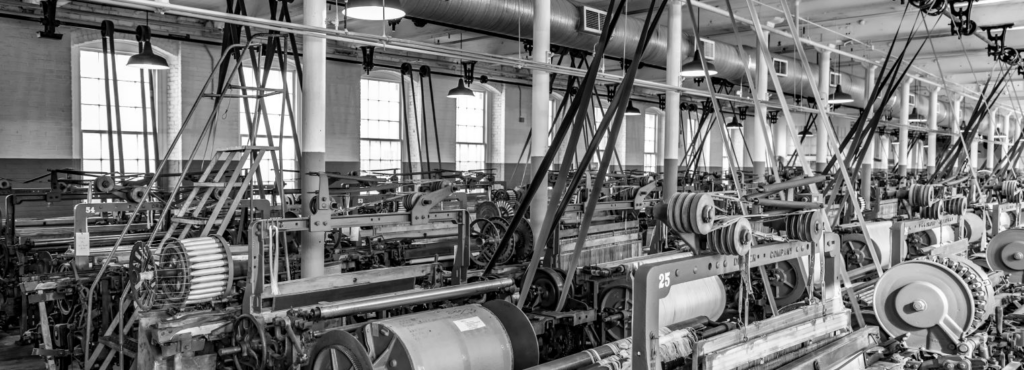
During the industrial revolution of the eighteenth and nineteenth centuries, the first factory machinery was driven by steam or water. Controlling these machines relied on mechanical linkages, chains, belts, and pulleys. Then, electrification, including Tesla’s development of the first induction motor in the late 1880s, went on to progress the factories of the twentieth century. This enabled the speed and accuracy of machine control to advance. By the 1930s, the introduction of basic electrical feedback formed the basis of early closed-loop systems.

In those days, a single, large line shaft could drive a machine, hard linked to rods, cams and pulleys. But, in a significant step forward occurring from the late twentieth century, early automated control began to include complex logic performed with relays, contactors and pneumatics.
Two advances around this time were the inventions of the programmable logic controller (PLC) and the variable speed drive, which began the shift to electronic control. In reality, this technology only started to become more frequently used within most factories from the mid-1980s. By this time, many custom electronic hardware solutions for the synchronisation or positioning of machine axes were also in use.
The demand from machine builders in the mid-1980s was to simplify mechanics, eliminate complexity, and introduce electronics to achieve faster, simpler development. A variable speed drive could control a single axis, and a PLC could control logic functions, but machine builders were also looking for increased speed and accuracy across multiple axes. PLC vendors looked to provide motion control add-ons, while new companies specialising in motion control began to emerge.
Enter: motion control

During the 1980s, the typical requirement for motion-centric projects was to replace mechanical machines featuring cams and conveyors with electronic control. Trio was founded in 1987, and the objective of its first design was to develop a supervisory, central controller with an integrated servo drive. With up to three synchronised axes at 250W, the CSC-250 became the first computer servo controller and represented the birth of intelligent drive systems.

The next significant development came in the early ’90s with a controller that could not only synchronise four axes but also had the capability to control an entire machine, just like a PLC, thanks to integrated I/O and expansion modules. This capability was quickly followed with a second-generation motion coordinator that could now take on up to 12 axes.
Both of these motion coordinator designs were based on pluggable daughter boards that gave the ability to mix servo and stepper control inside the same controller.
Multi-axis synchronisation over EtherCAT
By 2003, motion control capability had progressed to 24 axes, mainly by increasing the range of daughter boards. Controllers were able to run remote axes with communication protocols including SERCOS, SLM and CanOpen. However, the next significant technology leap came at the end of the decade with the release of a new generation of modular motion coordinators that could control up to 64 axes, with Ethernet built-in as standard.
By 2010, there were various contenders for the title of the leading Ethernet-based fieldbus for automated motion control. With its focus on high-speed cycle times and low jitter for accurate synchronisation, EtherCAT emerged as the leading performance technology.
Today’s motion control technology
Today, the most powerful motion controllers can synchronise over 100 axes with EtherCAT cycle times as low as 125μs, depending on axis count. Not all applications demand coordination across such a high number of axes, so pocket-sized controllers that support multi-axis applications and a range of click-in I/O modules are also available. Analogue as well as step and direction devices also remain in frequent use in addition to EtherCAT, and flexible motion controllers can also integrate these control options.
Crucial to overall machine performance, seamless integration between the motion controller and drive and motor axes is imperative. The drives themselves also need to include fast update rates while maintaining compact dimensions and a low cost per axis. Meanwhile, plug-and-play compatibility between the drive and controller is an important feature to ensure a fast and reliable set-up.

The importance of the motion engine
In combination with advanced hardware is the motion engine, the software environment that enables machine designers to develop motion applications. Motion engines should be able to achieve the required motion profiles, from simple to advanced motion trajectory profiling as well as kinematic structures including common robot types. Crucially, to enable fast development, motion commands and profile design should be accessible through an easy to use application programming interface (API), all of which can be simulated in a 3D virtual model to test and develop motion control.
Flexible motion engines enable engineers to use a variety of IEC 61131-3 languages and tools including PLCopen function blocks. However, languages dedicated to motion programming typically enable faster and more accurate development. These languages often use native English language commands that make it easier to create and review motion programmes, compared to languages such as ladder that follow a cascading format.
The future of motion control
For machines that primarily have a logic requirement, a PLC might be the preferable means of control. However, for applications where precise and accurate control of a machine’s axes remain fundamental, a controller focused on optimising motion will remain the most effective option.
A PLC or PC-based solution could leverage high processing power against the motion challenge, but with a purpose designed motion controller, this can be achieved with the equivalent of a mobile phone processor in a compact footprint, and at a fraction of the cost. Now, there’s also a trend for controllers with a foundation in motion coordination to integrate the kind of logic functions typically associated with a PLC. A motion controller with logic functionality can also involve IEC programming languages familiar to PLC users, which gives motion performance alongside a fast, simple set-up.

To improve productivity and efficiency in the factories of the future, robotics technology is increasingly common. Although robots aren’t new, and were first used in industrial manufacturing in the 1960s, we are seeing the growing integration of robots even across smaller machines and production lines.
Robotics is based on kinematic structures, which form the heart of motion control, and this means that motion-specialist engineers have a leading role to play thanks to their experience developing the moves within multi-axis motion control. These calculations, coordinated together into kinematic structures, ultimately comprise robotic movement. As the use of robotics is set to grow, industry’s reliance on advanced motion control can only increase.
Find out more about the solution for your motion needs.
(Originally Posted at: https://blog.triomotion.com/the-history-of-motion-control/)